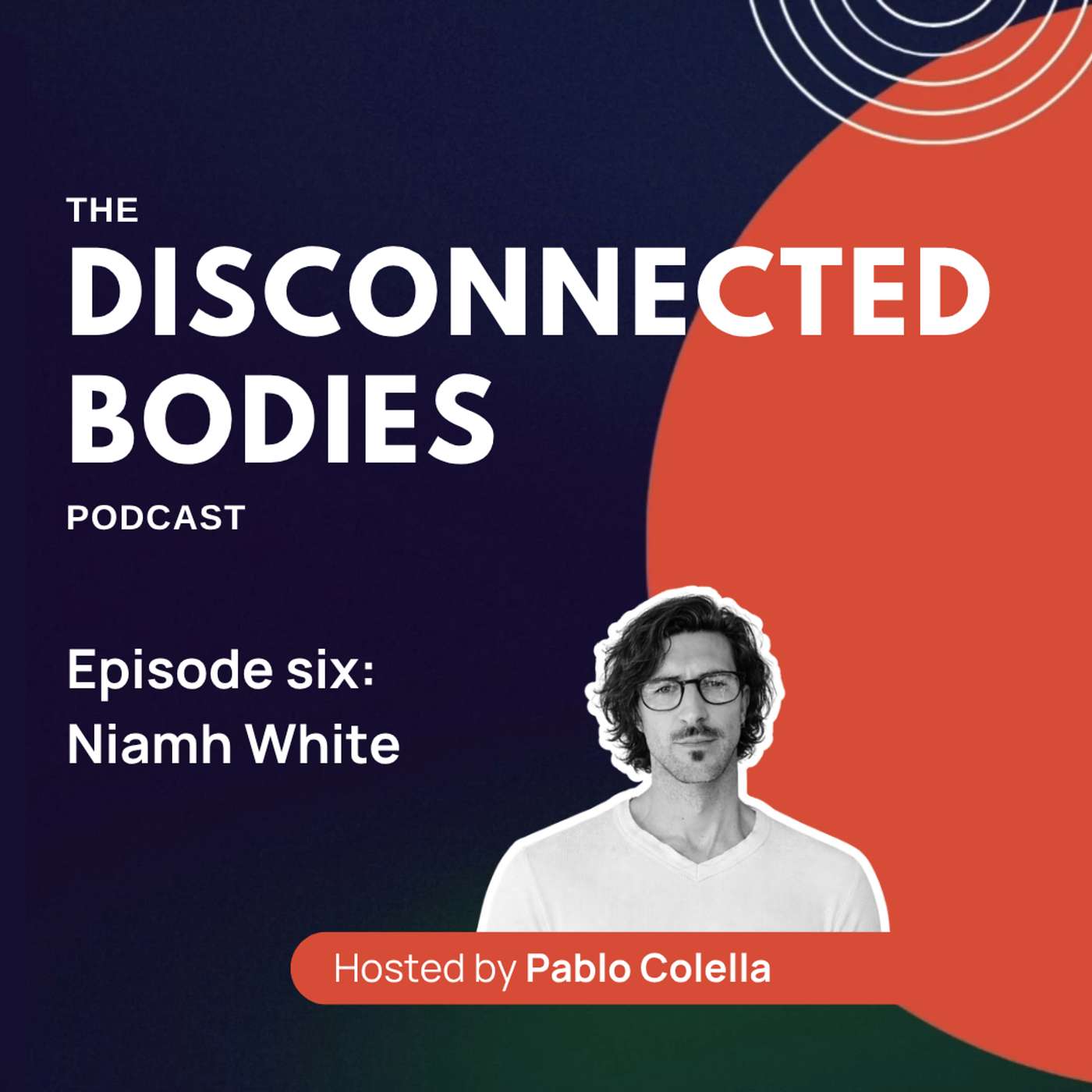
The Disconnected Bodies Podcast | Episode Six | Niamh White - CEO of Hospital Rooms
What's This About?
Niamh White is CEO of Hospital Rooms, a UK charity transforming mental health hospitals through contemporary art. Founded in 2016, the organisation has commissioned over 500 artworks and worked with more than 100 artists across NHS mental health sites nationwide.
To mark their 10th anniversary milestone, Hospital Rooms will deliver a year-long programme of activity in partnership with NHS Trusts across the UK and their Gallery Circle network, including leading international gallery Victoria Miro. Their anniversary programme will span new commissions, exhibitions, national participation initiatives and fundraising moments, with two major points of activity taking place in July and September 2026.
Visit www.hospital-rooms.com
The Disconnected Bodies Podcast
Hosted by Pablo Colella
For the curious and creative, The Disconnected Bodies Podcast is a space for bold conversations with leaders across the UK’s creative sector. Hosted by Pablo Colella, the series brings together diverse voices and sharp opinions from the forefront of culture, creativity, and change. From visionary artists to industry insiders, each episode unpacks the strategies, stories, and provocations shaping the creative landscape today, and asks what’s next for those daring to disrupt it.
About Disconnected Bodies
Disconnected Bodies is a UK-based social enterprise and arts audience consultancy dedicated to improving access to the arts, culture, and heritage.
Positioning creativity as a public good, they guide bold cultural projects and leaders in choosing, creating, and engaging “brilliant arts experiences”
Their services include:
- Audience profiling, research and evaluation – using dialogue-driven, psychologically informed methods to understand motivations and barriers
- Arts marketing and engagement roadmaps – strategic planning tailored for Arts Council England funded organisations
- Grant-writing support – helping clients secure public funding and amplify under‑represented voices
Key impact metrics:
- Operating for 19 years, across 15 countries.
- Reaching 720,000+ people in 2025, with 823 hours of free consultancy and 2.1 million digital engagements
At the helm is founder Pablo Colella, who's the UK's leading cultural audience psychology consultant.
SPEAKER_01: Um fundamental club is in the window, something stuck in with a problem. Something like this. Something that is to stop. How do we find a lesson and political? We can find some numbers. Some political numbers that we can struck. Bring it in.
SPEAKER_00: This is the Disconnected Bodies Podcast, hosted by Pablo Calum.
SPEAKER_03: Need, you're co-founder and CEO of hospital rooms, and you bring uh art into mental health care spaces, with this being your tenth year.
SPEAKER_01: Yeah, thank you for having me.
SPEAKER_03: So shall we start with the origin story? How did it all come about?
SPEAKER_01: Yeah, absolutely. Um I mean, I guess the first thing to say is we never expected to make hospital rooms, you know. Um my other co-founder Tim A. Shaw is an artist, he's my partner in life as well. Um, we both worked in the arts. Um, I was working in galleries and museums, he had a studio practice and uh business, fabricating artworks and working with artist studios, um, and that was the track we were on, you know, um, and we loved the work that we had been doing. Um, and then in 2015, a dear friend of ours was sectioned under the Mental Health Act, and she had to go into a mental health ward.
SPEAKER_01: Um, she was required to stay there as part of her care, but that space was dilapidated, run down, um sensory, kind of uh abrasive, and we felt that it was just completely incongruous with what you would hope for a loved one at that time. And you know, we were in the business of making beautiful spaces, mostly for quite wealthy people, in kind of um good circumstances, and you know, the opportunity kind of like arose, like, you know, with the idea came like there must be an alternative for this, you know, there must be a way that we can care for people who have a mental health diagnosis or are in mental health crisis in a space that tells them we care about you, you know, you're not forgotten, this isn't the end for you, you know.
SPEAKER_01: Uh, and that was the idea, you know, could you bring artists into these spaces, work with communities of patients and staff, understand something of that situation and people's needs and aspirations, and conjure up something entirely different. Um, so that was the idea, and uh of course, the first two years people kind of said to us, no, no way, you're ridiculous. This is impossible. Um but we were, I mean, we were driven by um anger in many ways, you know, that this was the situation for our friend and for eons of other people, and this kind of real belief that it could be different.
SPEAKER_01: Um, and then we were given a chance. So one uh, you know, risk-taking uh medical director at Springfield University Hospital said, Look, you know, there is one ward cares for people with a diagnosis of schizophrenia, have a go.
SPEAKER_03: You know, uh that's someone you need.
SPEAKER_01: That is, yeah, you need someone to open a door at one point. Yeah. Wow.
SPEAKER_03: And that's the thing, you have to open the door because it's all behind closed doors. You don't really have any insight into it as a unless you're in the situation or you know someone in that situation. It's just a bit of a mystery as to really what the care the care is.
SPEAKER_01: Yeah, and and their spaces, you know, you only encounter them at that crisis moment for the most part. Most people who are in an inpatient ward will have um probably often been subjected to the section of the Mental Health Act, which requires them to be there. Because otherwise, people do try to keep good within the community, provide care at home. You know, you are really quite unwell by the time you get hospital stay. Um, and at that point, for you, yourself, your family, your friends, you know, the fight is about recovery, it's not the wider systemic issue and structural issue.
SPEAKER_01: So that's where we felt, well, we actually have some room and time to be able to ha take on that fight, if you know what I mean.
SPEAKER_03: Yeah, that's amazing that you've could have seen it and still walked away from it. You know, you could have been that the sort of person who wanted to keep at arm's length and not actually wanted to get stuck in and make a change. I think to your credit, a lot of people would have done that.
SPEAKER_01: Well, uh and understandably done it, you know. Um and like I say, we never thought it would become what it has today. You know, we we had often Tim and I done exhibitions together or you know, done collaborations with artists or things like that. So we were thinking about it like one project, one ex like one experiment, even. And in our own minds, you know, there was an element of thinking we'll never do that, no one will ever let us in. Um, but then of course we managed to uh to get in that door.
SPEAKER_01: We had some artist contacts already who we knew would have, you know, an affinity with this, who would understand why this was an important thing to do. And I think it was 11 artists who came in with us and looked at each individual room, ran creative sessions with the patients and with the staff, um, you know, actually came up with compliant, you know, uh clinically compliant artworks that could be installed, um, and then produced them to a museum quality, you know, um, and that attracted a little bit of press.
SPEAKER_01: I think we were in The Guardian and we were in the BBC. Um, and then slowly, not you know, not immediately, it became a little bit easier. Some wards might come to us and say, you know, our ward is not looking good, could you help us? Um until, you know, four or five projects in, kind of the barrage came.
SPEAKER_02: Right.
SPEAKER_01: You know, so many wards across the country, so many hospitals, you know, saying, you know, the environments we are in are not reflecting the care that we're providing. Can you help?
SPEAKER_02: Yeah.
SPEAKER_01: And that's really when uh it became something more, you know.
SPEAKER_03: Alpha must have been amazing when that happened.
SPEAKER_01: Well, it's all gradual, isn't it?
SPEAKER_03: In what's was that was that a couple of years?
SPEAKER_01: Um so it was just Tim and I for a good two or three, maybe even four years. So we painted every wall, we were at every workshop, we worked with every artist, and then you know, as we were starting to run multiple projects at the same time, it became unsustainable. Um so then we started to take on people to kind of project manage different wards and things like that, and our team started to grow. Um, and then funnily enough, the pandemic struck. Oh but we're quite good in a crisis. Um we had to pivot, of course, because we couldn't enter wards anymore.
SPEAKER_01: We launched our digital art school, um, but we were very uh intentional about continuing the impact that we wanted to have, and then coming out of the pandemic again, you know, the demand was huge.
SPEAKER_03: Yeah, I can imagine.
SPEAKER_01: So there is a feeling that you're still not even making a dent. You know, that there is so much to do. Um and now, of course, we're a team of 22, uh, fantastic team. You know, I couldn't speak more highly of the people who work at hospital rooms, and I think that's um really well known and something I'm really, really proud of. Um, and our artist community as well, you know, none of this work would be uh possible without them.
SPEAKER_03: Do they have do you have regular artists like a portal?
SPEAKER_01: So yes, we have you know the artists who have done numerous projects with us and um you know have come on that journey, but we're always working with new artists as well, you know, and we're very particular about how we select artists, you know, how in this particular ward, this place, this community, who who is going to be, you know, most impactful. Um, and so sometimes that is artists who have worked with us a long time before, and sometimes it's an entirely new person who we're able to bring along, you know.
SPEAKER_03: Yeah. So uh a silly question. Um, why is art so important for mental health care?
SPEAKER_01: Well, I mean this is a big question, right? Because uh what we've seen over the last 10 years is a really um a fantastic development in terms of how we understand from a scientific basis how art can actually fundamentally improve our health. And Daisy Fankart has uh really led the drive on that. Um, we can see how it alleviates anxiety, it can lower blood pressure, it can reduce the need for pain medication. You know, so these wonderful, amazing things. Um, but I have to say, in hospital rooms, our mission is not to heal people, it's actually a social justice mission.
SPEAKER_01: It's thinking about how we value the spaces in which people with a severe mental health diagnosis um, you know, how that reflects how society values them. Um, and at present it's not good. And we believe that uh all of the people who are involved in that situation should be contributing to how we could possibly improve it. And I think the fundamental role that art can play here is in that imagining. You know, when you're so stuck in a wicked problem, something that is entrenched, something that is institutional, something that is historical, how do you find a way out?
SPEAKER_01: And I think that's where artists, you know, uh creative practice, poetry, we can find some windows, some alternative universes that we can then construct and bring into reality. Um, and that's where the magic of hospital rooms is, I think, because we have actually we don't just think about it, we don't just talk about it or propose a manifesto, or we actually do it, and we're prepared to kind of backtrack if we get it wrong. Um, but uh that bringing into reality is a very, very fundamental part of our identity.
SPEAKER_03: Yeah, and these spaces, um I think it's on your website, I don't think I've made this up. You you know, they're spaces of crisis and vulnerability. I think that's how you've described it. How do you work with that? Because that's a very delicate balance, I'm sure.
SPEAKER_01: You know, it is enormously challenging and enormously important.
SPEAKER_02: Right.
SPEAKER_01: Right? So you you can never be flippant about the situation that we're working in. Um and I think in many ways it's why we've never deviated on our mission. Uh uh, you know, along the years we have never kind of gone to cancer wards or to um, you know, stroke wards or we have been very particular about our identity as working within mental health settings, and we have been very purposeful about developing ways of working that are appropriate, that are sensitive, um, that also hold the artists in what is quite a charged situation and ask, you know, there is a real weight to the commission that we ask people to do.
SPEAKER_01: Um, and so yeah, we are drafting a curatorial methodology that will become what's called a national framework for access to arts and mental health. Um, and it poses a way of working in these spaces that take into consideration the real sensitivities that you're kind of navigating.
SPEAKER_03: Yeah, I think that's important that, as you say, it's purposeful work because you see quite a lot. There's work that happens in hospitals, but it's always, as I think of it, airdropped in. It's just picked up and put in an almost, if I'm being really skeptical about it, sort of done, and then wash your hands of it and sort of walk away. And this isn't what hospital rooms is at all. So it's you're working with okay, the artists, but also the patients, the staff in the in the in the hospitals as well.
SPEAKER_03: How does that all work? Like, have you got some examples of how the how the participants, like the the um would you call them patients? Is that or they're more they're more precisely.
SPEAKER_01: So it depends what setting we're in. So absolutely, um you know, for the most part we'll just say people. You know. Um, but of course, if you are an inpatient, you might be referred to that. Some people use terms like service user. Um so uh yes, we would be engaging people who are using services, maybe fem family and friends, crucially NHS staff. Um, but when we yeah, when we run a project, you know, it's possible to think hospital realms is an arts organisation, but really I think it is a people organization.
SPEAKER_01: Um, and what we are trying to do is um support culture change, right? You know, um, and so when we work with a hospital ward, we we tend to be with them for one or two years. Um, so that enables us to uh run these six phases that we've come up with that lead in an iterative way to the next. So, for instance, our first phase is just research and development. So it means members of our team are spending time on the ward absorbing as much as they possibly can. So they will be thinking about the architecture, you know, how is that experienced?
SPEAKER_01: Um, they'll be thinking about the demographics in the space, you know, what is the diagnosis there, how long might people be staying, um, the acuity of uh people's situation. They'll also be looking at field-based research, so they're looking at the wider kind of cultural landscape, you know, who is local to this mental health ward, who might be a great partner that once we've closed our project might continue this access to creativity in our stead. Um, they'll also be running what we call creative discovery sessions.
SPEAKER_01: So things like you know, established methodologies like photo voice, um, like collage evaluation set uh sessions, um, creative methodologies of asking people how do you experience a space and what what was you, you know, how if you could dream up um the perfect mental health space, you know, for the quiet room, for the dining room, for you know, where you take medication, what would that be? And and helping people dream of that beyond, you know, a tree or you know, complex, nuanced ways of bringing that out of people.
SPEAKER_01: And that helps us design the project, that helps us to select our artists to look at what the kind of co-production method looks like for the artworks. So is it every Tuesday at two? Because we know there's a window that people will actually be able to come in a place that they, you know, are familiar with. Um, is the content going to be appealing to people? Um, so all of that goes into the design of that co-production um season with the artists, and I think there is a really interesting binary within arts and health between the helicopter and the kind of moral, you know, we engaged people, and I think that that opposition isn't so helpful because I think there's real complexity in in co-production, and it can look and feel very different in different scenarios.
SPEAKER_01: So that listening phase, that phase where we're learning, helps us to construct a situation where people can contribute in a way that they can and want to, and that fundamentally the most important thing is that there's total clarity. This is the way in which we are asking you to participate. This is how your input will be um used or integrated or not, um, and so that people have a real understanding of who you are, what you're doing there, um, and it's not kind of like, oh, hello for the afternoon, uh, you know, we're here to do some art, what do you want?
SPEAKER_02: Yeah.
SPEAKER_01: You know, it's uh much more situated than that. And I suppose there's um we've built that over the years and built that into our budgets and built that into kind of the the real kind of fibre of the project so that that's possible. Um but it you know it's magic when it happens.
SPEAKER_03: Yeah. I can imagine. I can I mean you you've had the experience, so you know how to design it, I'm sure. But it's um it sounds lovely that you're it's it's a long-term like relationship. Because even if you're not sort of airdropping yourself in, some projects only last say six weeks.
SPEAKER_02: Yeah.
SPEAKER_03: So if it's over a longer period of time, you I I presuming you build up that trust with people, with everyone really. Um and then people's guards. They can people can let down their guards a little bit more and engage deeper, I guess.
SPEAKER_01: Yeah, and there are very few shortcuts to that, that trust and that relationship building, particularly again in this situation. Um and I suppose we are really interested in producing extremely high-quality creative programs and artworks. And so having the time to spend on the research elements, on that kind of absorption of people's experiences, you know, proposals that you know have to be worked and reworked in order to make them compliant, you know, it does require time.
SPEAKER_02: Yeah.
SPEAKER_01: Uh but then I suppose our frustration is so much to do. Right. You know, uh, and so then we think through like the pillars and the ways in which we are able to, you know, these are the inch-wide mile deep projects, you know, they are the kind of ambitious ways of demonstrating what's possible in these spaces. But then we have like volume pieces. So, for instance, the digital art school delivers really beautiful art materials that are donated by Windsor and Newton to every hospital in England, as well as a kind of online programme to save NHS staff time and say, look, this is an activity that works in an inpatient ward.
SPEAKER_01: Ten minutes, you can watch it, um, and you can here's your risk assessment, you know, here's everything you need, here's your poster, you can go. Yeah, you know, uh these staff are so stretched for time, um, trying to do their best for um, you know, their patient group. So these are ways in which we can just kind of you know support that.
SPEAKER_03: Yeah. Let's talk about the digital art school whilst you bring it up because so there's that's available online. That's for so for anyone who really wants to it doesn't have to be in this setting. It absolutely anyone who's and what's what's on the website at the moment?
SPEAKER_01: So the aspiration of the digital art school is that it's competitive with kind of the RCA or the Slade or um, you know, any of those really fantastic art schools, but that it infiltrates spaces where really they cannot reach. So if you imagine we have RCA tutors, Mark Titchener, Harold Offay, um Abasa Hadi um coming up with sessions that you know we've worked with them on to make a program. For an impatient ward. They use the materials that are in the box that we've delivered. And we have short form and we've got long form, and people can just have them on in the space and you know participate along in whatever way suits them best.
SPEAKER_01: But yes, it is completely free and accessible on our website and on YouTube. So the idea is, you know, we've seen it used in libraries, we've seen it used in schools. So it's kind of opening up access again to say to these like fantastic artists who have so much to give and so kind of willing and generous to give it. Um but you know, also for people in their own homes. Um, you know, that evidence we've been talking about demonstrates that you know, not everyone can access the kind of calming effects of meditation.
SPEAKER_01: You know, meditation takes practice and it's not there for everybody, but art making can actually bring up those same benefits as a meditation. So, you know, being able to just pop it on and engage in a short art activity can bring you down, you know, it can support mental health in a much more day-to-day manner. Um, and of course, we've got huge aspirations for the digital art school.
SPEAKER_03: Yeah, it's I mean, it's incredible. That in it in itself is a resource. Like we do that little bit of work in access, and um like yesterday we were working with a a care home and that sort of thing is would be so valuable to to well to to the the pe the the residents but also the carers because the care as you say the carers are rushed off their feet and to organise something once a week or yeah and it not have to be on their heads to organise it, yeah. And you've got the the expertise in that it's not you know I mean the carers are lovely, but they haven't got the background, so to have that extra what a fantastic resource.
SPEAKER_03: That should be you should have all the backing from everyone on that. I hope you're getting enough funding to do that. There's never enough funding, that's the thing. There's never enough, but it's there, so um you know it's an incredible resource for anyone if they come across it.
SPEAKER_01: And you know, there is you know untold potential for it. At the moment it's a kind of inventory of things people can access, but you know, we wonder what if it could be more interactive, you know, what if there could be you know um accreditations or qualifications that people could actually be recognised for having completed certain things, or um, you know, how people could interact with one another or you know, share their work with one another. So, you know, technically there's a lot of work that can be done with it.
SPEAKER_01: Um, our focus at this moment is really getting it naturalized in NHS services, but it certainly remains one of our very kind of core focuses and activities.
SPEAKER_03: Yeah. And just because you you you went through it quite quickly, let's just reiterate art material in every hospital, that's no small achievement. No You said it so blasy, oh art material, that's incredible.
SPEAKER_01: Well, it's funny, Tim and I come up with these ideas sometimes in somehow we do manage to do it. So we've done it twice now, we'll do it again this year. Um we the idea was kind of based around those beautiful kind of um luxury advent calendars or um you know luxury boxes that you open because so often in these mental health walls you just see the worst quality things, you know, the dried-up falk-tip pens, the jigsaws without the pieces missing. And we just wanted to say, you know, you're loved.
SPEAKER_01: You know, this is this is and the boxes are designed. The first box was designed by Jose Parla, who's a fantastic contemporary artist based in New York. Um, the second one was Michaela Year with Dan, another artist based here in London, represented by Hauser and Worth Gallery. These are fantastic artists, they do a beautiful exterior of the box. They are quality materials in there, you know, beautiful paints, paintbrushes, watercolour paper, um these beautiful pens, all uh donated um by Windsor and Newton, which is an enormous gesture.
SPEAKER_01: Um but again, it we just learned that was just such an enormous barrier. You know, we could have made the videos, but we can't do it because they don't have the things, you know, they can't, you know.
SPEAKER_03: You wouldn't have known that unless you're actually on the ground, that's the thing, isn't it?
SPEAKER_01: Yeah, yeah, absolutely. Um so yeah, it's it's uh a really something we are really proud of. You know, it took a lot of work to get off the ground. Um but uh yeah something will continue and hopefully ramp up.
SPEAKER_03: Yeah. So you're working in these spaces which I'm presuming have lots of rules, regulations like clinical spaces. So how do you work with those are they would you see them as restrictions or you know that something you have to work around?
SPEAKER_01: Yes, so there's enormous um compliance. Um and and you know, you might argue that that is why these spaces are the way that they are, um, because there is very little room for invention because of of the demands that are placed on the space keeping people safe. Um but in one way those restrictions um are like enormous fuel for creativity. You can't do this, you can't do this, you can't do this, you can't do this, what can you do? You know, and and that fuels like really ingenious thinking. Um, and again, artists are the best people to do that, you know, with a material knowledge, um, you know, with a very broad conceptual frame to draw on.
SPEAKER_01: Um, you know, and and on our side, we encourage them to be ambitious and to be adventurous and to kind of of course we will never be flippant about those restrictions because we will never take people's safety, you know, um uh or put that at risk. But we kind of think there are ways. You know, there are ways to do that and be beautiful or and be comforting, you know, both and kind of situation. Um so some of those things are like wipe clean, um, no framing, no glazing, no screws. Um we often end up painting directly onto the wall, or um mounting materials like dye bonds that can be scrubbed.
SPEAKER_01: We can't really have textiles or fabric. Um it matters about what's kind of protruding from a wall, or um so all of those things are really, really important.
SPEAKER_01: Um but part of the work is also giving courage to those decision makers who might allow us to do that, right? You know, so not being flippant about that either, and making sure that we know who is a decision maker and involve them from day one. Yeah, who are we? What is our intention? In what ways have we gone about doing this? Um, and giving them the chance to be brave, you know, in a situation where it's not easy, you know, it's not easy to stick your neck out, it's not, you know, there are potential repercussions if you get something wrong and all of those things.
SPEAKER_01: So I think it's about helping people to embrace something new. Yeah. Um, so that's another really big piece of of the work that we have to do all the way through. Um, but then it can pay off when you know you end up with something just fantastic and it it has it has met those needs.
SPEAKER_03: Um it's as you say, it's just working with people, I guess. It's just understanding what they need as well. I guess it's no no well, it's underplaying it to say it's no more complicated than that. I'm sure it's very complicated. But you know, with yourself and Tim's personality, I think it comes across that it's there's a genuine, like an intent an in good intention behind it, and it's not just as I say, like bulldozing your way through. Uh so I don't think you can downplay how important that is really.
SPEAKER_01: Yeah, it's all relational. Yeah. Yeah.
SPEAKER_03: So obviously you're you're funded, so you have to have the uh the impact reporting that goes along with the funding. How do you document the impact that you're doing when it's not so much necessarily bums on seats? Yeah, yeah, yeah.
SPEAKER_01: I mean, evaluation has been quite a big part of hospital rooms from the very beginning. Um, and sometimes it can be frustrating and you you're kind of thinking, oh god, another form, you know, particularly for funders and everything else. But I have to say, I feel very strongly that you do need to be accountable, particularly with work like this. So, in one sense, you need to know that actually the thing that you're doing is doing what you think it's doing and is successful, you know, is having a good impact.
SPEAKER_01: Um, and you also need to know where you need to learn, where you need to develop, what you need to change, where you failed. You know, and we try and encourage that culture at hospital rooms to say you can fail. We can try, you know, we've got uh a kind of risk appetite. Where are we we're not we're not we don't have any risk appetite for that health and safety piece, but we do when it's you know for trying something new, a new approach, a different idea. You know, I hope the team really feel they can come to us and say, what about that, you know?
SPEAKER_01: But it's like what about that? But but let's test it, yeah, and then let's figure out if it was effective, if it was less integrated, if it wasn't less let it go, let's try something else. So we do it in a number of ways, and in the first instance, it was very simple. You know, there was an element of just making sure you know how many people did come, yeah, you know, how many people you engaged with and who they were. Um there can you know we've used things like sentiment analysis, so you might use something like emojis and ask people which emoji kind of describes their feeling before a session and after a session, as simple as that.
SPEAKER_01: And um, you know, people like the Arts Council have other sentiment tools like Insight and Impact, where you're asking people, here's a statement, how much do you agree with it on a scale of one to ten circle? So very kind of simple things. Um, above and beyond that, I've mentioned the creative methods that we've used in the research and development phase, but that also comes back again in the in the end of a project, so that we are getting really rich qualitative data about how people have experienced the project from start to finish and enabling them to kind of articulate that in a language that suits them.
SPEAKER_01: Um, and we've done some really fantastic work with Norwich University of the Arts and a group of co-researchers who have lived experience of mental health services to try and tease out, you know, what what actually is important for an art project to achieve in mental health services. Um, and that's really enriched the you know that qualitative um data that we gather. And then above and beyond that, we've participated in more um kind of clinical-based um collaborative research projects. We did that with South London and Maudsley and HS Trust, and they um supported us with a project that was in a psychiatric intensive care unit, and that was published in um a peer-reviewed journal.
SPEAKER_01: We've recently completed a research project with Jameel Arts and Health, and that was an international project looking at the effect of murals on um people in the US, in England, in Nigeria, and in Slovenia. So it goes from the small to the very big, um, and that again has been developed over time. Um, but I suppose the other thing to really think about within mental health service is that people are evaluated, you know, to such a degree that I I would really urge people to wonder what do I really need to find out?
SPEAKER_01: Yeah. Because if you don't need to know, don't gather it if you don't, if you're not going to use it, if it's not important to you. And you know, we've really tried to kind of backtrack away from any kind of form or anything that looks like an NHS kind of like qual sheet or a well-being measure, or because you know, we can get a lot of that data through our means, through the arts, through arts methods. Um and I suppose you don't want to contribute to people's um sense of being an object that is constantly measured if you don't need to.
SPEAKER_01: Um so yeah, it's a complex one, but you know, foundationally and fundamentally important, um, but one to be thought about in complexity, like everything else.
SPEAKER_03: Yeah. So before we um we round up, let's talk about this this framework that you're doing with the NHS, because that's a massive two-year project.
SPEAKER_01: Yeah, two or three years, yeah.
SPEAKER_03: Could you explain what that's yeah?
SPEAKER_01: So if you imagine over these nine, ten years, we have figured out a way of working, you know, quite organically. So the spaces we're working in are generally those locked and secure inpatient mental health boards. So that might mean um psychiatric intensive care, acute services, forensic services where people have been in touch with the criminal justice system, children and adolescent services, so they all kind of come in, you know, they're they're specialized and different services, but the regulation and the compliance and the level of restriction is kind of similar.
SPEAKER_01: So our question is how can you run, you know, really meaningful creative projects and transform the environments within these spaces effectively. And we kind of had figured out a way of doing that, you know, and we were running our projects in that way. And I suppose that weight of kind of feeling like, okay, we've done 63 wars, there's still 400 and you know, there's too much work for us to do on our own. So this idea has come about to actually get it down. Um, to we're basically commissioning 52 artworks across the country using this methodology, and during each stage gathering that data, you know, looking at it from both a quantitative and qualitative perspective, writing that up, um having it scrutinized with a peer group, drafting it again, um, to the point where hopefully we have something of a user manual for one way of doing this work.
SPEAKER_01: And you know, that will enable hospital rooms to standardise and to scale and to grow, but we also intend on open sourcing it. So to say to any artist, any arts organization, or even any NHS trust, this is how you could do it yourself, you know, um, and have that model of almost consultancy support, you know, being on the end of the phone. We have precedent for it because we work with the Art of Healing, which is an organization in Lagos, um, and that's what we do. We give them our framework, and we're on the end of the phone when they need it, but they're able to adapt it, to change it, to kind of apply it to psychiatric wards there, um, and it's working.
SPEAKER_01: So, you know, it feels like another step on, another way of kind of elevating and expanding the impact that the we're able to have. Um, but that work goes on now until kind of middle of next year, which is it's really exciting. It's very kind of uh vibrant and full of people contributing amazing things. Um, so yeah, it's a great piece of work.
SPEAKER_03: And not that it it will be the end, but what an amazing legacy to have.
SPEAKER_01: Yeah, exactly.
SPEAKER_03: That doesn't come around very often.
SPEAKER_01: Yeah, I think you know, Tim and I would really hope, you know, hospital rooms isn't going anywhere, but you see a lot of projects like ours where in the end it's kind of like that was nice when that happened once. Wasn't it good when that organised you know, that one hospital in da da. And I think that's what we would really like to not be.
SPEAKER_02: Yeah.
SPEAKER_01: You know, we would really like to make a shift. We would like to kind of see some kind of systemic change as a result of the work that we're doing. You know, whether we get that or not, I don't know.
unknown: Yeah.
SPEAKER_03: I think I think you will. I think that's I think uh your track record shows that you would probably will.
SPEAKER_02: Yeah.
SPEAKER_03: I think. Um so yeah, let's round this up. So what's coming up with uh hospital rooms this year? You mentioned there's a new probe, like an activity programme.
SPEAKER_01: Yes, so amazingly, it's our tenth year. So we are using that as an opportunity to have uh you know a number of celebratory events um to reflect on what we've done and to kind of look forward, you know, on the work that there is to do. Um, we've got a number of different ways that people can join us and be involved. There's exhibitions coming up across the country in Bristol and Birmingham. Um, we also have a major exhibition at Victoria Miro in September, um, and we'll be presenting new works uh that are being completed at the moment on the kind of these huge works on the outside of a hospital in London.
SPEAKER_01: Um, and we also have an auction at that time, a big fundraising drive. Um, so yeah, lots going on. Um, an amazing milestone, really. Um, but yeah, exciting to look forward as well.
SPEAKER_03: Yeah. So if anyone wanted to get involved or wanted to find out more, you've got the website, um, social media, and all this sort of stuff. Yeah, absolutely.
SPEAKER_01: Yes, yeah, there's a newsletter on there that will kind of um deliver all the information about these upcoming events. Um, we have a friend scheme where people can support the work that we do and get involved. Um, we also have uh an NHS open call coming up as well. So if people are working in hospitals, they can get in touch with us and and talk to us about projects coming up in 2027 to 2029. Um, so yeah, lots of ways to get involved.
SPEAKER_03: Amazing, thank you so much. Uh this is one I've been looking forward to for a couple of months. Um, it's amazing what you're doing. I know everyone who's uh involved is thinking it's amazing, and I think everyone who comes across it is going to think it's amazing. So um, yeah, thank you so much for your time.
SPEAKER_01: You're really kind, yeah. Thank you so much.
 Apple Podcasts
 Castbox
 Castro
 Goodpods
 Moon FM
 Overcast
 Pocket Casts
 Podbean
 Podcast Addict
 Podcast Republic
 Spotify